A single sump pump is standard. A second sump pump is insurance. In Ontario’s climate — with its freeze-thaw cycles, spring deluges, and increasingly intense storm events — specifying dual sump pumps on architectural drawings is one of the most consequential calls an architect can make for a client’s long-term peace of mind.
It rarely makes the headlines of a design review. It doesn’t appear on a mood board. But buried in Division 22 of the project specifications is a decision that could be the difference between a dry basement and a $50,000 flood restoration claim. When we specify mechanical and plumbing systems for residential and mixed-use projects in Ontario, dual sump pump systems deserve to be a standard of care — not an optional upgrade.
Ontario’s Water Problem Is Getting Worse
Ontario homeowners are no strangers to water ingress. The province’s geology — much of it sitting on clay-rich soils that retain moisture — combined with its variable climate creates persistent hydrostatic pressure against foundation walls. Add to this the dramatic increase in intense rainfall events attributed to changing weather patterns, and the risk profile for below-grade spaces has risen considerably over the past decade.
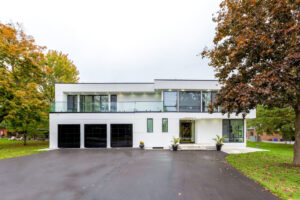
Flat-roof and low-slope residential construction — increasingly popular in urban infill and modern custom home design — compounds the issue. Without the benefit of steep roof pitch to carry water rapidly away from the building envelope, ponding and slow drainage become ongoing challenges. That water eventually finds its way into the ground surrounding the foundation, directly increasing the load on the drainage and sump system below grade.
“A sump pump doesn’t fail at a convenient time. It fails during the worst possible storm, when the ground is saturated and the water table is highest.”
Mechanical equipment fails. Sump pumps — typically low-cost, high-cycle workhorses — are particularly vulnerable. They run hardest during the exact conditions when failure is most costly: sustained rain events, snowmelt, and spring thaw. A pump that has been cycling for 12 hours straight in a saturated site is under tremendous stress. Motor burnout, float switch failure, power outages, and debris clogging are all real failure modes that happen routinely.
Why Architectural Drawings Must Specify It
This is precisely why the specification must do the work — not the contractor’s judgment, not the homeowner’s assumption, and not a verbal note during site review. If the architectural documents are silent on sump pump redundancy, the default is a single unit. Every time.
Contractors price to specification. If the drawings show one sump pump pit and the specs describe one pump, that is exactly what will be installed — efficiently and compliantly. The cost to add a second pump during construction is minimal: a second unit in the same pit, connected to the same discharge line with a check valve on each branch, with the secondary pump set to a slightly higher activation threshold so it only engages when the primary cannot keep pace. The hardware cost is typically in the range of $400–$800. The rough-in labour, when done at the same time as the primary installation, adds perhaps an hour or two of mechanical work.
The cost of omission? A basement flood during a primary pump failure can easily exceed $30,000 to $80,000 in remediation, replacement of finishes, contents loss, and temporary displacement — not including the psychological toll on the client and the reputational risk to the design team.
The Architect’s Obligation
Specifying building systems that protect the client’s long-term interests is not above and beyond — it is part of the standard of care. A dual sump pump specification costs nearly nothing to write and potentially saves everything.
How to Specify It Correctly
Dual sump pump systems should be specified under Division 22 — Plumbing, with clear language that establishes both units as primary components, not as one primary and one “backup” relegated to a lesser product category.
Recommended Specification Language
At minimum, the specification section should address the following:
- Two sump pumps per pit: Specify that each sump pit shall contain two independently operable submersible sump pumps, each sized for the anticipated peak flow rate of the drainage system.
- Staggered float switch activation: The secondary pump float switch shall be set 25–50mm above the primary pump activation level, ensuring the secondary only activates upon primary failure or insufficient capacity.
- Independent check valves: Each pump shall be equipped with its own swing-type or spring-loaded check valve on the discharge branch prior to combining at the main discharge line.
- Dedicated GFCI-protected circuits: Each pump shall be connected to a separate dedicated GFCI circuit — never share a circuit between both units, as a tripped breaker eliminates both pumps simultaneously.
- Battery backup consideration: For higher-risk sites (high water table, flat roofs, below-grade habitable space), specify that at least the secondary unit shall be a battery-backup-capable model or that a separate battery backup unit shall be provided in addition to the two primary pumps.
- Alarm integration: Specify a high-water alarm with audible alert and, where the project includes a smart home or building automation system, a notification relay so the owner receives a real-time alert if water levels rise above the secondary pump activation point.
Specification Summary: Primary vs. Secondary Pump
| Parameter | Primary Pump | Secondary Pump |
|---|---|---|
| Activation threshold | Base level (e.g., 150mm above pit floor) | 25–50mm above primary activation |
| Motor capacity | 1/3 to 1/2 HP (site-specific sizing) | Equal or greater than primary |
| Circuit | Dedicated GFCI, 120V | Separate dedicated GFCI, 120V |
| Check valve | Individual, on discharge branch | Individual, on discharge branch |
| Discharge | Combined after individual check valves | Combined after individual check valves |
| Battery backup | Optional | Strongly recommended on high-risk sites |
| Alarm | — | High-water alarm with notification relay |
The Flat Roof Factor
Contemporary Ontario residential design has embraced flat and low-slope roofing — and rightly so. Clean lines, accessible rooftop terraces, and the ability to integrate green roofs or solar arrays make flat roofs an attractive design choice. But they demand a more rigorous approach to site drainage and foundation waterproofing than conventional pitched-roof construction.
On a sloped roof, a heavy rain event disperses water rapidly toward eavestroughs and away from the building. On a flat roof with interior drains, that same rain event sends water directly into the building’s drainage infrastructure — and ultimately into the ground surrounding the foundation. When the roof drain and the perimeter drainage system are both under peak load simultaneously during a storm, the sump pit is the last line of defense.
This is precisely the scenario where a single pump motor failure becomes a basement flood. The dual-pump specification for flat-roof projects is not merely a good idea — it is a design response to a known and quantifiable risk.
A Note on Client Communication
Clients rarely ask about sump pumps. They are not glamorous. They do not appear in architectural photography. But when an architect proactively explains the dual-pump specification during a design review — framing it clearly as protection for their investment and peace of mind — the reception is almost universally positive.
The conversation takes two minutes. The specification line takes thirty seconds to write. The protection it provides lasts the life of the building. This is the kind of design thinking that distinguishes a thorough architectural practice from one that leaves the details to chance.
The best detail in a set of drawings is the one that quietly prevents a disaster the client never even knew was possible.
At Lima Architects Inc., our standard residential specifications now include dual sump pump systems as a default for all new construction projects in Ontario — particularly those with below-grade habitable space, flat or low-slope roofs, and sites with known high water table conditions. We encourage colleagues across the profession to do the same.
The next time you open Division 22, take thirty seconds and add the second pump. Your client’s basement — and their insurance deductible — will thank you.
FAQs
-
1. What is the average cost per square foot to build a custom home in California?The average cost per square foot to build a custom home in California ranges from $400 to $700. High-end and luxury homes in coastal or major urban markets often command prices of $800 to $1,000 per square foot. Final pricing depends on location, design complexity, material selections, labour rates, and regulatory requirements.
-
2. Does the cost per square foot include land and permits?No. Cost per square foot generally reflects only construction costs. Land acquisition, architectural and engineering fees, permit and impact fees, site preparation, utility connections, financing costs, and contingency allowances are calculated separately. In California, these additional items can represent a significant portion of the total project budget.
-
3. Why is it more expensive to build a custom home in California than in other states?Building a custom home in California is more expensive due to strict seismic codes, Title 24 energy requirements, environmental regulations, high labour costs, and extended permitting timelines. Coastal regulations, hillside construction constraints, and prolonged approval processes further increase overall project costs.
-
4. How much should I budget for architectural and design services?Architectural and engineering services typically account for 10% to 15% of the total cost to build a custom home. This includes architectural design, structural engineering, energy compliance documentation, and coordination with consultants. Investing in comprehensive design services helps reduce construction risk, limit change orders, and protect the overall budget.
-
5. What contingency budget is recommended when building a custom home in California?A contingency fund of 10% to 15% of the total construction budget is strongly recommended. This allowance helps cover unforeseen conditions such as soil issues, utility upgrades, permit delays, material price fluctuations, and weather-related impacts that commonly arise during custom home construction in California.
Next Steps
Toronto retail succeeds when landlords and developers design the ground floor as an operating asset that supports tenant flexibility, omnichannel operations and a safe, comfortable public realm all year round. Small technical decisions — such as modular storefronts, glazed setbacks, base-building MEP headroom, and quick-install canopies — compound into measurable increases in rent, lower vacancy exposure, and stronger neighbourhood value. Pair these design moves with an early AST/PAC strategy and clear leasing packages to maximize ROI and shorten time‑to‑income.
If you’d like a Toronto-specific review of a storefront or ground-floor strategy, Lima Architects can assess your site, run a short pro forma showing likely rent uplift, and outline the municipal and construction steps required to achieve it. Request a free consultation with Lima Architects to turn your street retail into a competitive, year‑round asset.